
By: Emily Apadula, Senior Policy Analyst
In the second and third quarter of 2026, many states continued to consider the possibility of explicitly legalizing plug-in solar, a trend that began last year. Since the beginning of this year, more than 50 bills related to plug-in solar were considered in 35 states and DC. More information on the background of plug-in solar and actions taken in the first part of the year can be found on our blog post: Plug-In Legislation: Bills Defining Portable Solar Propagate Across the Country (February 2026).
However, at the end of the first quarter of 2026, Utah, which passed legislation in 2025, remained the only state that had enacted enabling legislation. During the second and third quarters, seven additional states followed suit and passed legislation allowing plug-in solar. Additionally, lawmakers in Delaware adopted a resolution to study the safety and utility of portable solar devices.
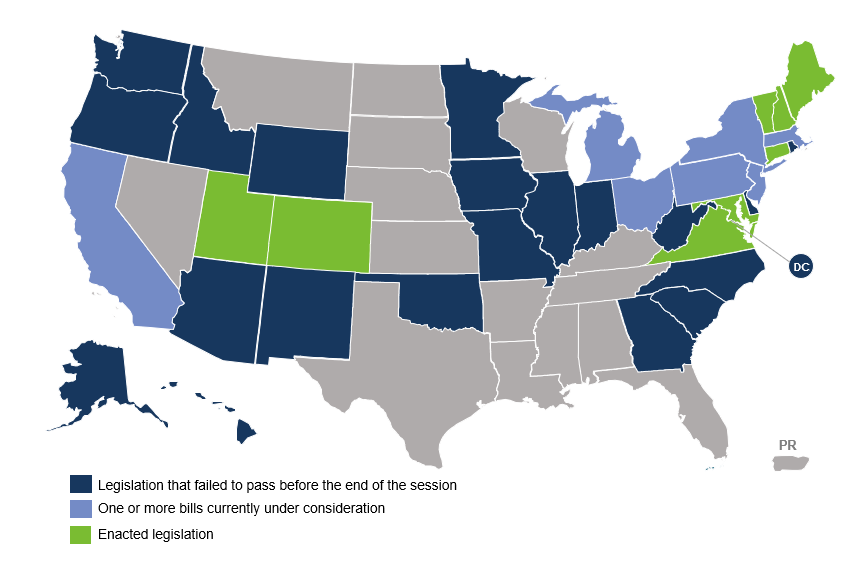
Recently Enacted Legislation:
Colorado: (H.B. 1007)
Enacted on May 7, 2026, H.B. 1007, defined portable solar as systems up to 1,920 W and certified by a nationally recognized testing laboratory. Customers are limited to one device and devices must not have the ability to energize the grid during an outage. Utilities are prohibited from requiring customers to obtain approval for installation, pay a fee related to the device or install additional controls or equipment beyond those in the device. Smaller devices, up to 391 W, are exempt from installation requirements and building safety code provisions. However, beginning in 2027, such smaller devices are prohibited from being sold, leased, and/or rented. Through this legislation, portable solar would be considered an energy efficiency measure.
Connecticut (H.B. 5340)
Signed by the Governor on June 4, 2026, H.B. 5340 defines portable solar as devices up to 1,200 W that are certified by a nationally recognized testing laboratory. Devices are exempt from interconnection requirements and installation approval and fees charged by utilities. However, the devices must include a feature that prevents it from energizing the building’s grid during an outage.
Maine (L.D. 1730)
On April 6, 2026, the Governor signed L.D. 1730, allowing plug-in solar devices with an export capacity of up to 1,200 W to be used by customers to offset part of their electricity consumption. Devices must be listed and certified Underwriters Laboratory (UL) 3700 or applicable UL LLC or National Electrical Code standards, or under comparable standards from a nationally recognized testing laboratory. Devices with a combined inverter output up to 420 W may be installed without notification, however, devices 420 - 1,200 W must be installed by a licensed electrician on a dedicated circuit and the customer must notify the utility of installation. Utilities may not prohibit installation or require approval, studies, fees, or additional controls. These devices are ineligible for net metering.
Maryland (H.B. 1532)
Enacted on May 12, 226, H.B. 1532, allows for portable solar devices up to 1,200 W. Devices must be certified by the Underwriters Laboratory or an equivalent. Systems up to 391 W are exempt from listing requirements from the UL that would require alterations to the building’s premises, writing, or electrical panels. Utilities are prohibited from requiring approval, fees, or additional controls.
New Hampshire (S.B. 540)
S.B. 540, signed by the Governor on July 2, 2026, allows plug-in solar devices that comply with national standards up to 1,200 W. Customers are not required to obtain utility approval, complete an interconnection review, or pay fees related to the device. However, the utility may develop a method for customers to inform them of such device installation.
Vermont (S.B. 202)
On June 16, 2026, S.B. 202 was enacted, allowing portable solar devices, up to 1,200 W and certified by a nationally recognized testing laboratory, to be installed. Devices must be designed to be connected to a building’s electrical system via an electrical cord plugged into a receptacle and must include a feature that prevents it from energizing the building’s electrical system during a power outage. Devices may must smart meters but are ineligible for net metering.
Virginia (H.B. 395 and S.B. 250)
H.B. 395 and S.B. 250, enacted on April 22, 2026 allow for portable solar devices up to 1,200 W that are designed to connect to a building’s electrical system through a standard outlet. Devices must meet the most recent standards of the National Electrical Code and be certified by the UL or equivalent nationally recognized testing laboratory. The bill prevents local governments from restricting the use of such devices, so long as the devices are in compliance with zoning requirements. Landlords are also prohibited from preventing installation, but may establish reasonable restrictions on the size, place, and manner or placement of devices. Such devices are also ineligible for net metering.
Pending Legislation:
Legislation has also been passed in New Jersey and New York, and is awaiting final action by the states’ individual Governors. In addition to New Jersey and New York, legislation is pending in five other states - California, Massachusetts, Michigan, Ohio, and Pennsylvania.
Want to keep up with legislation related to plug-in solar, consider subscribing to DSIRE Insight’s Distributed Solar Policy Tracking products.