

By Justin Lindemann, Project Manager (NCCETC) & Ann Collier, Director for Grid Strategy (SEPA)
To date in 2026, utilities have proposed 25 new large-load tariffs and service rules. In parallel, regional grid operators have developed or proposed solutions to address large-load impacts on interstate transmission and wholesale power markets, including creating options for large loads to operate flexibly in exchange for faster interconnection. This blog post summarizes recent database updates and situates the load flexibility provisions found in tariffs relative to other key policy mechanisms that also promote increased large-load flexibility.
About DELTa
In July 2025, the NC Clean Energy Technology Center (NCCETC) and the Smart Electric Power Alliance (SEPA) launched the Database of Emerging Large-Load Tariffs (DELTa), which is a first-of-its-kind public-access resource that tracks and summarizes utility tariffs and service rules for large-load customers, including data centers. Since then, DELTa has helped over 1,400 policymakers, utility regulators, and utilities plan for load growth, understand common financial safeguards that ensure growth pays for growth even under extreme or unexpected scenarios, and assess how positive benefits of growth are distributed across the grid. DELTa has become a transparent source of information in regulatory filings, industry analysis, and the media.
Annual Growth in Large-Load Tariffs
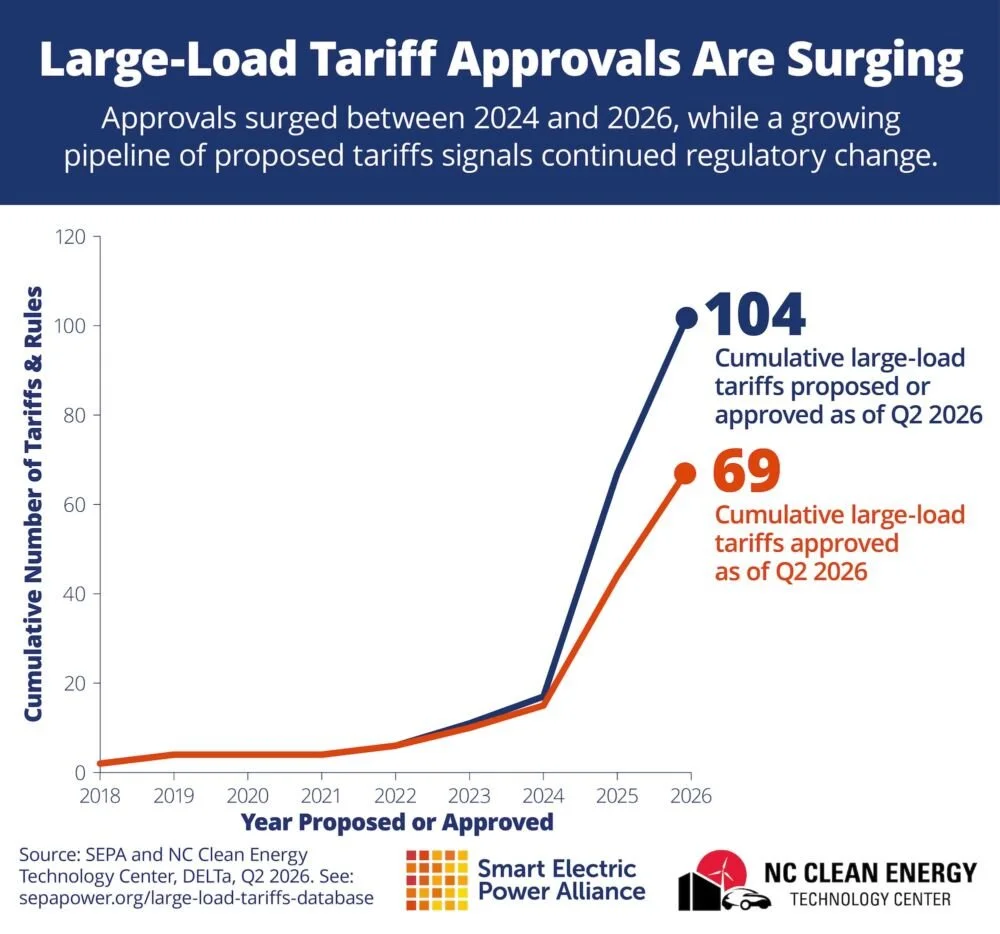
The pace of large-load tariff development has accelerated considerably in the four years since AI and data center load growth gained national attention. In the last year alone, our data have grown from 41 proposed and approved tariffs and rules in July 2025 to 104 in July 2026. These numbers underscore how important large-load rate design has become in the search for energy solutions that balance American competitiveness in the AI race with safeguards for electricity affordability and reliability.
Q2 2026 Updates
Following our new quarterly update, DELTa now provides summaries and analyses of 104 approved and pending tariffs and service rules across more than 70 utilities, spanning public power, cooperative, and investor-owned utilities. Key points from the Q2 DELTa data include:
69 approved utility tariffs and service rules targeting large-load or data center customers
35 proposed utility tariffs and service rules targeting large-load or data center customers that are currently awaiting regulatory decision
37 states with one or more tracked tariffs or service rules (approved + proposed)
45% of tariffs and service rules (approved + proposed) specify a large-load threshold of at least 50 MW peak demand, which is one part of the threshold that the Federal Energy Regulatory Commission (FERC) recommended using to define large loads in its transmission-level interconnection show-cause orders from June 2026
Large-Load Tariffs Are One Pathway to A Flexible Grid
As of Q2 2026, one-quarter of the large-load tariffs and service rules we track in DELTa include a concrete option for dispatchable large-load flexibility or codify other large-load curtailment pathways. Large-load flexibility refers to the ability of any large customer, including data centers and other commercial and industrial facilities, to temporarily shift or reduce its grid-supplied electricity consumption during periods of peak demand or grid stress. Done well, increased flexibility reduces the risk of peak time outages, lowers the need for peaking generation capacity, and is envisioned as a way to ease interconnection backlogs. In large-load tariffs, the contractual mechanism for flexibility typically is an optional interruptible service rider, but there are also examples of large-load tariffs specifying a role for utility dispatch of behind-the-meter generation or demand response programs.
Tariffs are just one of the ways industry is structuring large-load flexibility. In particular, state governments, wholesale market operators, and customers are also working to facilitate large-load flexibility, studying and proposing an array of mechanisms like wholesale market rules, state legislation, cross-agency working groups, and bespoke interconnection agreements. Each mechanism brings tradeoffs and considerations such as how quickly it can be implemented, how much of a benefit it provides to customer interconnection speed and to the grid, degree of regulatory transparency, and crucially, how palatable the solution may be to local stakeholders and customers.
Large-load flexibility implementation in large-load tariffs and broader energy policy
Utility Tariffs
Pennsylvania’s Model Large-Load Tariff (2026): Model tariff for 50 megawatt (MW)+ loads (100 MW+ aggregated) includes interruptible service options tied to PJM’s Emergency Load Response Program.
Xcel Energy’s (MN) Large Peak Controlled Time of Day Service (2026): Optional interruptible rate for 100 MW+ load customers with 3 MW+ of controllable load who can curtail grid use during peaks or high price events.
Wholesale Market Rules
Southwest Power Pool’s Conditional High Impact Large Load Service, ‘CHILL’ (2026): Offers expedited non-firm transmission interconnection for large loads, which may be shed first during curtailment events.
FERC’s ‘Show Cause’ Orders Under Section 206 of the Federal Power Act (2026): Directs six regional grid operators to justify or reform existing large-load interconnection rules, including providing new transmission services for flexible large loads.
State Legislation
Texas S.B. 6 (2025): Requires 75MW+ loads with onsite backup generation to disclose capacity to utilities and accept ERCOT emergency curtailment; utilities will develop firm load-shedding protocols for transmission-voltage customers.
VA H.B. 284 and S.B. 371 (2026): Requires utilities to create load flexibility programs for customers 25 MW+ and 75%+ load factor.
Cross-Agency Working Groups
North Carolina Energy Policy Task Force (2025): Recommended additional study of voluntary large-load demand response options.
Washington Data Center Workgroup (2025): Urged agencies to incentivize load flexibility through tax incentives or other means.
Bespoke Agreements
Georgia Power’s Load Flexibility Compliance Report notes that the utility inserts load flexibility terms into its large-load contracts, focusing on onsite generation and cross-location workload shifting.
Google’s load flexibility partnerships: Has publicly shared plans with Omaha Public Power District, the Tennessee Valley Authority, and Indiana Michigan Power, taking steps to reduce data center power during grid constraints by shifting non-urgent computing.
Sources: DELTa (2026), NCCETC 50 States of Power Decarbonization quarterly policy analysis reports.
The growing recognition and implementation of large-load flexibility offers significant benefits. Ultimately, grid success depends on how effectively states implement these pathways to onboard large loads while protecting reliability and customer affordability. See the latest DELTa update to learn more about the above examples of utility tariffs with large-load flexibility — or reach out to our teams for a complimentary briefing on the other types of large-load flexibility policies we monitor.
Contacts
SEPA and the NCCETC developed and maintain the Database of Emerging Large-Load Tariffs (DELTa).
Submit the form on DELTa’s home page to join our mailing list, or click here to sign up for the NCCETC newsletter for additional energy industry news and resources.
Justin Lindemann, N.C. Clean Energy Technology Center, jplindem@ncsu.edu
Ann Collier, Smart Electric Power Alliance, acollier@sepapower.org