
By: Brian Lips, Sr. Project Manager
On July 2, 2026, the U.S. Department of Energy (DOE) released a Notice of Proposed Rulemaking (NOPR) related to federal appliance efficiency standards. A press release announcing the proposed rule change was titled, “Trump Administration Moves to Permanently End Green New Scam Appliance Mandates.” The Administration has a long history of opposition to appliance standards, so it is no surprise that the DOE would act against them. But will the rule change truly end appliance efficiency standards?
The Appliance Standards Awareness Project (ASAP) estimates that without appliance standards, over the past decade, electric consumption in the U.S. would be 14% greater, households would have paid $6,000 more in utility bills, and businesses collectively would have spent $330 billion more. But their full impact exceeds that, since appliance standards have been around far longer than just the past decade.
California set the stage for the first appliance standards following the 1973 oil crisis. The Warren-Alquist Act of 1974 established the California Energy Commission (CEC) and gave it a multifaceted mission that included a requirement to “prescribe, by regulation, lighting, insulation, climate control systems, and other building design and construction standards which increase the efficient use of energy.” Shortly thereafter, the CEC formally adopted the first standards, which took effect in 1977. The federal government devised its own response to the oil crisis in 1975 with the Energy Policy and Conservation Act. That law, however, only required the development of energy efficiency improvement targets, not binding standards. It wasn’t until the enactment of the National Energy Conservation Policy Act of 1978 that DOE was required to adopt mandatory appliance efficiency standards. The rulemaking process was slow for DOE, spurring Congress to revisit the issue with the National Appliance Energy Conservation Act of 1987, setting minimum efficiency levels in the statutory code and requiring DOE to simply implement them. By that point, Massachusetts and New York had joined California in adopting their own appliance standards.
Since then, Congress has added efficiency standards for additional product types, and introduced water efficiency standards for various plumbing products. According to ASAP, DOE has now adopted efficiency standards for a total of 63 products, including a mix of residential, commercial/industrial, plumbing, and lighting products. More states also joined California, Massachusetts, and New York in adopting their own standards. Today, 17 states plus DC currently have their own appliance standards in place, covering a total of 22 products.
States with Appliance Standards (as of July 2026)
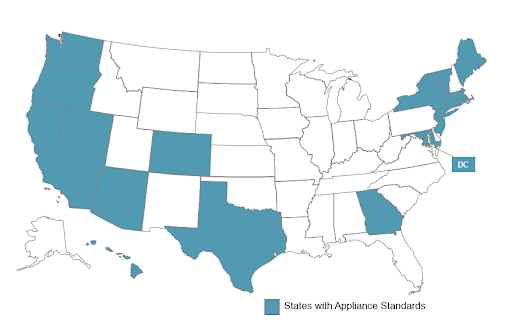
In most cases, these states actually adopted standards for more than the 22 currently state-enforced products. However, 42 U.S.C. § 6297(c) provides that federal efficiency standards preempt state standards, even if the state standard is more stringent. As DOE has adopted standards for a broader suite of products, these state standards have been superseded, though there are mechanisms by which a state may seek a waiver. In the case of faucets, showerheads, toilets and urinals, there is even a self-executing waiver mechanism the other product types do not have. Therefore, while the DOE adopted water efficiency requirements for these plumbing products, fifteen states plus DC are able to continue enforcing more stringent requirements.
DOE, as directed by Congress, routinely reviews and updates its efficiency standards for each product. In determining the appropriate efficiency level for a given product, 42 U.S.C. § 6295(o)(2)(A) requires that any new or amended standard must be “designed to achieve the maximum improvement in energy efficiency, or, in the case of showerheads, faucets, water closets, or urinals, water efficiency, which the Secretary determines is technologically feasible and economically justified.” Later in the statutes, Congress requires new or amended standards to result in “in significant conservation of energy.” Which brings us to the core element of the recent NOPR.
The NOPR does not propose to repeal any of the current appliance standards; it would need an act of Congress for that. Instead, it proposes certain revisions to the process by which DOE adopts new or revised appliance standards. In February 2020, DOE adopted a rule applying a numerical value to “significant conservation of energy,” requiring any rule revision to result in a reduction in site energy use of at least 10% over a 30-year period. The DOE reversed itself under a new administration in December 2021, and adopted a rule removing the 10% threshold; allowing DOE to make a “significant conservation of energy” determination on a case-by-case basis. The new NOPR reimposes the 10% threshold and changes the basis from site energy to “full fuel cycle” (FFC) energy. FFC energy incorporates upstream energy losses, which include generation, transmission, and distribution losses for electricity, and extraction, processing, and leakage losses for gas.
These changes will likely give an advantage to natural gas appliances, making it more difficult for electric appliances to meet the 10% threshold. As a result, DOE will be less likely to adopt new or revised appliance standards. However, the proposed rule change will have no bearing on the existing standards, to say nothing of the state-adopted standards. Taken together, the Administration may want to revise the title of its press release, but a true analysis would make for a much more boring title.
To learn about state appliance standards, visit the Database of State Incentives for Renewables and Efficiency.