
By: Brian Lips, Sr. Project Manager
Plug-in solar systems, also referred to as portable solar or apartment solar, are small photovoltaic systems coupled with a microinverter that can plug directly into a standard home electrical outlet. They are not intended to offset the entirety of a home’s electricity usage, and will not export electricity to the grid. Instead, the power remains within the home, where it can lessen the amount of power the home draws from the grid or power single devices.
Despite the simplicity of these systems, they potentially face a complex web of state, utility, and/or local government regulation. Typical roof-mounted systems require interconnection and net metering agreements with the local utility, and a building permit and electrical permit from the local government. While that level of scrutiny may be justified for a system permanently affixed to a roof and designed to feed meaningful amounts of power onto the grid, it may be overkill for a properly designed plug-in solar system. But in the presence of regulatory ambiguity, a utility or consumer may feel compelled to comply with the existing approval process.
Massachusetts, New York, Pennsylvania, South Carolina, and Utah introduced legislation in 2025 to clarify the regulatory process, or lack thereof, for plug-in solar. Utah’s bill, H.B. 340, was signed into law in March 2025, while bills in Massachusetts, New York, Pennsylvania, and South Carolina were carried over into the new year. H.B. 340 defines a portable solar generation device as meeting the following criteria:
A maximum power output of 1,200 watts
Designed to be connected to a building’s electrical system through a standard 120-volt outlet
Intended primarily to offset part of the customer’s consumption
Meets the standards of the most recent version of the National Electrical Code
Certified by Underwriters Laboratories or an equivalent nationally recognized testing laboratory
For portable solar generation devices that meet all the criteria above, they are not subject to a utility’s interconnection requirements and net metering rules. They do not need any form of approval from their utility, and will not be assessed any fees. While it was novel to see similar legislation appear in three states in 2025, we have seen an explosion of comparable legislation in 2026. As of mid-February, more than 50 bills related to plug-in solar were under consideration in 29 states and DC.
Plug-In Solar Legislation Under Consideration (as of late February 2026)
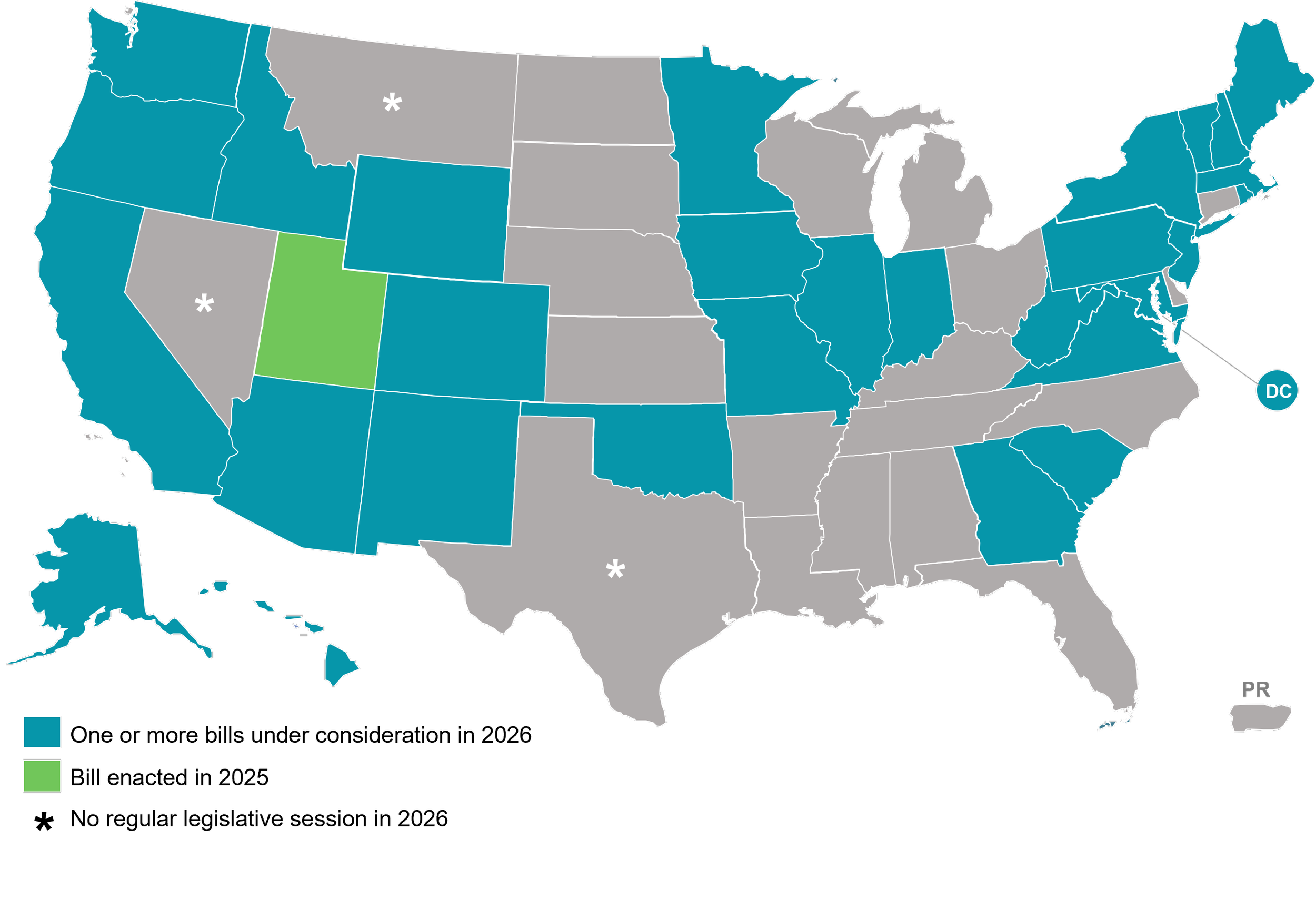
While all of the bills have nearly identical definitions for plug-in solar or portable solar, there are some variances in the degree of regulatory relief afforded them. The bills uniformly exempt plug-in solar from the traditional interconnection rules and associated fees, but some bills also address net metering. In some cases, like H.B. 4516 in Illinois, it is couched as plug-in solar being exempt from rules associated with net metering, while other bills, like H.B. 2435 in Hawaii prohibit plug-in solar from participating in net metering. An even smaller selection of bills address other potential barriers, including H.B. 4524 in Illinois, which prevents homeowners' associations from prohibiting, unreasonably restricting, or imposing fees on plug-in solar systems, and H.B. 395 in Virginia, which prohibits local governments from restricting their use.
Taken together, these legislative efforts suggest that plug-in solar is moving from a regulatory gray zone to a recognized product with a defined pathway to widespread use. As more states standardize definitions, clarify exemptions from interconnection and net metering rules, and even preempt local or private restrictions, regulatory certainty will increase and help unlock broader adoption.
Want to keep up with legislation related to plug-in solar, consider subscribing to DSIRE Insight’s Distributed Solar Policy Tracking products.