
By: Caitlin Flanagan, Policy Analyst
Over the last several months, the NC Clean Energy Technology Center has simultaneously been updating its Carolinas ordinance database, crafting a solar and storage model ordinance for NC, and tracking energy policy topics - including storage permitting - across all fifty states. Across these separate activities, storage and solar permitting trends arose.
While our first Carolinas ordinance database update and accompanying trends analysis focused on individual category standards such as setbacks, height restrictions, and visual requirements, this update uncovered broader zoning and permitting trends as well as more restrictive development elements found across the Carolinas. Further, the analysis helped provide an understanding of the NC energy storage landscape when developing the solar and storage model ordinance. As storage-specific obstacles became clear in the ordinance drafting process, so too did some potential reasons for the apparent lack of energy storage ordinances.
Renewable Energy Technology Ordinances in North Carolina Counties (March 2026)
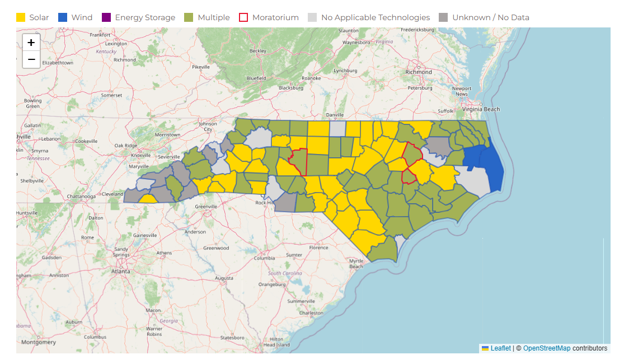
Source: Carolinas Development Assistance and Siting Hub, https://carolinas-dash.org/ordinance-database
Zoning Trends
In North Carolina, 81 counties address solar in their zoning ordinances, though a handful do not assign substantive zoning and permitting standards to solar. Only 14 counties address battery energy storage in their ordinances. Zoning districts where solar and storage are permitted vary widely across counties in NC, with some counties permitting development in all zones and some permitting only in extremely limited zones. On the one end, Halifax County, NC allows large solar in all zones, but with different permit types and standards across the different zones.
On the other end of the spectrum, Yadkin County, NC only permits solar energy facilities with a special use permit in the rural agriculture zone, and solar facilities are limited to 5% of total county land. The most common approach was permitting solar through a special use permit, though several counties did allow for by-right permitting, and some required a specific solar energy facility permit or high-impact land use permit. By-right permits allow for certainty around project standards, allowing projects that comply with the standards for a certain use to gain a permit after review and inspection by the relevant authorities. Special use permits require quasi-judicial hearings, meaning that projects may undergo a more rigorous permitting process with less certain results. However, special use permits can also allow greater consideration for project-specific factors and how they interact with zoning standards.
In summary, all projects are generally permitted across residential, industrial, commercial, and agricultural zones, depending on size and acquisition of the appropriate permit. Industrial zones are the most common for permitting projects, followed by agricultural, commercial, and residential.
Project Permitting
Of the 14 counties that address energy storage, seven counties regulate energy storage within their definition and requirements for solar energy facilities. Edgecombe County, NC regulates battery energy storage under the definition of wind energy facilities. Davie County, NC allows storage as an accessory use. Allowing energy storage to be an accessory use to a solar or other renewable energy generator primary use can often be an appropriate approach. Further, defining storage as a part of a solar facility may have been the path of least resistance for these counties. However, it is also important to recognize the unique, separate standards that battery energy storage facilities require. Without establishing these separate standards, including energy storage in a wider solar definition may not be sufficient.
The University of Michigan’s model battery energy storage bylaw takes the approach of thinking about solar and storage as two separate uses, which may be reviewed under one permit application when they are co-located. Model bylaws from Massachusetts and New York take similar approaches of defining the uses separately but also considering hybrid or co-located scenarios. Lincoln County, NC was the only one to define storage as a separate primary use.
A Charged Question: Why do so few North Carolina counties address energy storage standards when utility resource plans call for significant buildout?
As stated in Duke Energy’s 2025 Carolinas Resource Plan preferred portfolio, beginning in 2026, energy storage nameplate capacity additions are recommended to reach 6,500 megawatts by 2035 and 9,450 megawatts by 2040. Yet, in the face of storage market development, very few counties had substantive standards for energy storage at all, let alone for a separately defined energy storage use.
Energy Storage Technology Ordinances in North Carolina Counties (March 2026)
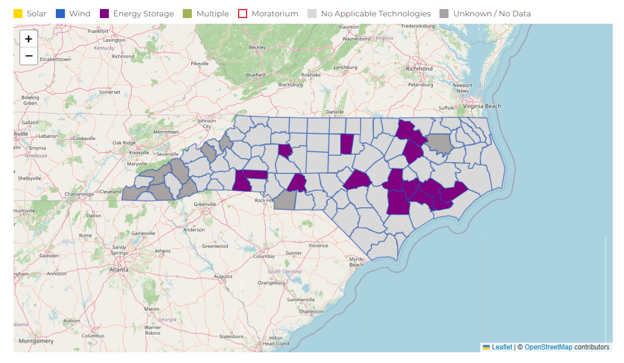
Source: Carolinas Development Assistance and Siting Hub, https://carolinas-dash.org/ordinance-database
One reason could simply be the scope of the ordinance analysis. The Center examined each county in the Carolinas, but several other authorities having jurisdiction (such as municipalities) may regulate storage. For example, the Town of Knightdale permitted a Duke Energy battery storage system on an existing substation parcel zoned as manufacturing and industrial, which allowed the new battery storage use to be reviewed and approved administratively. Furthermore, energy storage uses may in effect be regulated in accordance with standards applied to similar uses, such as utility, manufacturing, and industrial uses.
Another potential factor may be North Carolina’s approach to state versus local jurisdiction over energy facility land use standards. In North Carolina, land use standards for energy facilities including solar and storage are left largely to the local authority having jurisdiction. This allows for communities to design and adopt standards that reflect the community priorities that are represented, but it also means that communities that lack capacity may not be able to adopt specific standards and that land use decisions on similar projects can vary widely across communities. Several other states have passed laws captured by DSIRE Insight that provide minimum or maximum standards for solar and storage. South Carolina’s H.B. 3309, enacted in 2025, requires all counties that have not adopted solar design standards to comply with the standards outlined in the bill, including setbacks, buffers and screening, fencing, noise, and decommissioning.
Relevant to storage, Illinois recently passed the Clean and Reliable Grid Affordability Act (S.B. 25), which allows counties to adopt standards for areas outside of municipalities, but only if they are not more restrictive than specified in the bill. The bill outlines setbacks, fencing, noise, and safety requirements. It further limits permit fees and the grounds on which an energy storage project can be denied or restricted. Another notable approach is the state “backstop” route demonstrated by Michigan’s 2023 Renewable Energy Siting Law. Projects over a certain megawatt threshold require state permitting at the Michigan Public Service Commission if the local government does not have an ordinance that is no less restrictive than the standards outlined in the law.
For NC jurisdictions looking for additional guidance or capacity, the Center’s new model solar and storage ordinance outlines provisions covering setbacks, screening, fencing, height, noise, glare, signage, permits required, application elements, commissioning, and decommissioning. Per best practices from renewable energy technology-focused non-profits and stakeholders, jurisdictions are encouraged to first consider if existing standards for similar uses in a given zoning district are sufficient. Where jurisdictions determine that additional standards are necessary to meet a community purpose, the model ordinance aims to provide clear, measurable solar- and battery-specific standards for compliance based on input from the variety of stakeholders who participated in the process.
A final potential factor: Some states, including Illinois and Michigan, allow local jurisdictions to incorporate industry safety standards legally, while the landscape is more complicated in North Carolina. NFPA 855 is the National Fire Protection Association’s code with minimum requirements to mitigate the hazards associated with energy storage systems. Michigan’s and Illinois’ laws outlined above explicitly stipulate that energy storage facilities must comply with the most recent version of NFPA 855. However, states do not uniformly incorporate, or allow local jurisdictions on their own to incorporate, the most recent version of NFPA 855 in their state fire code or battery standards.
North Carolina is still operating under the 2018 NC State Building Code, since the effective date of the 2024 North Carolina State Building Code has not yet been determined. The 2024 NC State Building Code is an amended version of the 2021 International Fire Code (IFC), which incorporates battery energy storage provisions from NFPA 855, though NFPA 855 has been amended with relevant provisions since the 2021 IFC. NC code officials generally may not inspect to a standard that has not been adopted in NC, i.e. more stringent than the currently effective NC State Building Code. This may be leaving local officials and project developers to mitigate safety concerns based on their expertise, but with limited options for codification and enforcement.
The model ordinance takes this landscape into account, allowing jurisdictions options to decide which route of NFPA 855 consideration is right for them. Jurisdictions may include a provision strongly encouraging that applicants request that Code Enforcement Officials apply the 2024 code to their project in order to incorporate NFPA 855 in an enforceable way. Additionally, they may include a provision encouraging voluntary compliance with NFPA 855. Other counties may consider including NFPA 855 compliance as a condition of a discretionary permit, though this has only been proposed as a text amendment and not adopted in NC at time of writing.
This NC case study highlights several of the major factors that stakeholders will need to consider when it comes to adding energy storage capacity in their state:
What capacity or resources do certain local jurisdictions have to develop and adopt storage siting and permitting standards?
What is the landscape of state versus local jurisdiction for siting and permitting?
What purview do states versus local jurisdictions have to adopt industry standard safety codes?
As demonstrated by the different approaches across state and county, there is no one-size-fits-all approach to solar and storage zoning. However, the Center’s DSIRE Insight tracking, ordinance database, and model ordinance provide evidence and examples of how different jurisdictions have made their own way, as well as a guide for local jurisdictions to get started.