
By: Rebekah de la Mora, Project Manager
As interest in nuclear energy grows, policymakers must consider various facets of the industry - siting, permitting, and construction; operations and regulatory compliance; technical and feasibility research; supply chain, workforce, and economic development; financial and regulatory incentives; and other issues. As the nuclear industry gets bigger and the existing nuclear workforce grows older, its demand for skilled labor will also grow, and workforce development policies will be critical in creating that skilled labor.
Workforce development can be supported by nuclear training and education programs, financial incentives encouraging skilled hiring and competitive positions, and stakeholder groups developing recommendations around workforce development. Both legislators and governors have the authority to establish programs, allocate funding, or create research groups, though the jurisdictional authority of each entity may vary state-to-state.
State Action on Nuclear Workforce Development in 2026
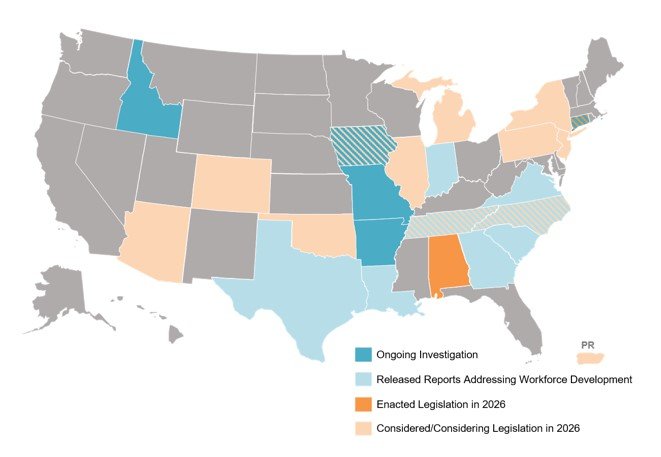
Policymakers can establish stakeholder groups or agencies to research and develop recommendations around nuclear energy issues, including workforce development programs. Nuclear task forces or working groups in Idaho, Iowa, and Missouri are charged with exploring and supporting workforce development, including training programs and academic partnerships. The Kentucky Nuclear Energy Development Authority assists communities with advanced nuclear opportunities, including economic development and transitioning away from fossil fuels plants to nuclear plants. The Texas Advanced Nuclear Energy Workforce Development Program targets higher education, training programs, research and leadership development, degrees, and certificate programs via financial incentives, curriculum development, and strategic planning.
State and regional stakeholder reports on the nuclear economy often include sections on workforce development. Reports from Purdue University, the University of Texas at Austin, and the Southeast Nuclear Advisory Council analyzed the economic impacts of nuclear development in Indiana, Texas, and the Southeast (Georgia, North Carolina, South Carolina, Tennessee, and Virginia). The reports outlined the expected number of jobs, economic revenue, and tax base impacts for different types of projects, among other analyses. Louisiana’s Nuclear Strategic Framework called for a comprehensive incentive toolkit for generation and fuel conversion to help strengthen the nuclear workforce.
The Tennessee Nuclear Energy Advisory Council recommended that the state establish a jobs tax credit multiplier for nuclear projects that create jobs and that the Tennessee Nuclear Energy Workforce Center launch a three-year pilot; meanwhile, strategic energy plans in Utah and Virginia encouraged overall workforce training and education for nuclear energy. The Connecticut Council for Advancing Nuclear Energy Development must study the demand for skilled labor in the industry, with a final report due in 2028. In addition, the Arkansas Public Service Commission must conduct a technical feasibility study on nuclear energy, including a socioeconomic assessment that covers the impact on workforce education and training.
State and federal governments can provide funding or training programs to encourage workforce development. The JobsOhio Energy Opportunity Initiative will provide $100 million over five years to help offset costs associated with energy development, including nuclear workforce training. Washington State University received $1.4 million in federal grant funding to support its nuclear workforce training capabilities and establish a new Reactor Ready initiative for future nuclear energy careers. The Governor of Tennessee announced $10 million for the Governor’s Investment in Vocational Education targeting nuclear workforce education. Virginia lawmakers provided funding to higher education through two grant programs - the Nuclear Education Grant Fund and the Power Innovation Fund - to support workforce development, among other things.
The Governors of Idaho, Utah, and Wyoming signed a memorandum of understanding to collaborate on nuclear energy innovation, including workforce development; the New York Power Authority also signed a memorandum of understanding, with Ontario Power Generation, which covers workforce development in New York and Ontario, while legislative chambers in Kentucky and New Hampshire both resolved to support workforce development - Kentucky through the federal Nuclear Energy University Program and New Hampshire through a new educational and workforce training program. The Governor of Illinois ordered the Illinois Power Agency and Illinois Commerce Commission to explore funding for a nuclear training academy and to assess and train the nuclear workforce.
Legislation Considered in 2026 Related to Nuclear Energy Workforce Development
While the above policies and programs have already been implemented, policymakers continue to examine ways to promote nuclear workforce development. Pending legislation in various states targets workforce development through statewide initiatives, grant funding, higher education programs, and community transition planning. Overall, workforce development policies emphasize the role the state can play in growing the nuclear industry, whether it's by providing funding, offering training programs, spearheading studies into the civilian nuclear economy, or establishing targeted authorities and offices to more efficiently lead the way.
Interested in more nuclear policy actions? Check out our biannual Nuclear Policy Data Sheet! The data sheet covers workforce development along with licensing & permitting, re/decommissioning, market development, advanced fuels, waste treatment, project procurement & deployment, facility conversions, international cooperation, and more. Data sheets can be purchased through DSIRE Insight.