
By: NC Clean Energy Technology Center and Smart Electric Power Alliance
Two states enacted virtual power plant (VPP) legislation, Massachusetts set a target of 3.5 GW from new load-management strategies (including VPPs), and Minnesota greenlit a $430 million distributed battery program – all in the first three months of 2026. Momentum on VPPs and supporting distributed energy resources (DERs) remained strong in Q1, with activities spanning new program mandates, energy storage procurement, managed charging, and DER market design across more than two dozen U.S. states.
This quarterly update from the N.C. Clean Energy Technology Center (NCCETC) and the Smart Electric Power Alliance (SEPA) summarizes the most important VPP-related regulatory, legislative, and utility actions in Q1 2026, and previews what to watch for in Q2. For a broader view of the policy landscape, our 50 States of Virtual Power Plants & Supporting Distributed Energy Resources: 2025 State Policy Snapshot provides a comprehensive roundup of actions that unfolded nationwide last year.
Q1 2026 Updates
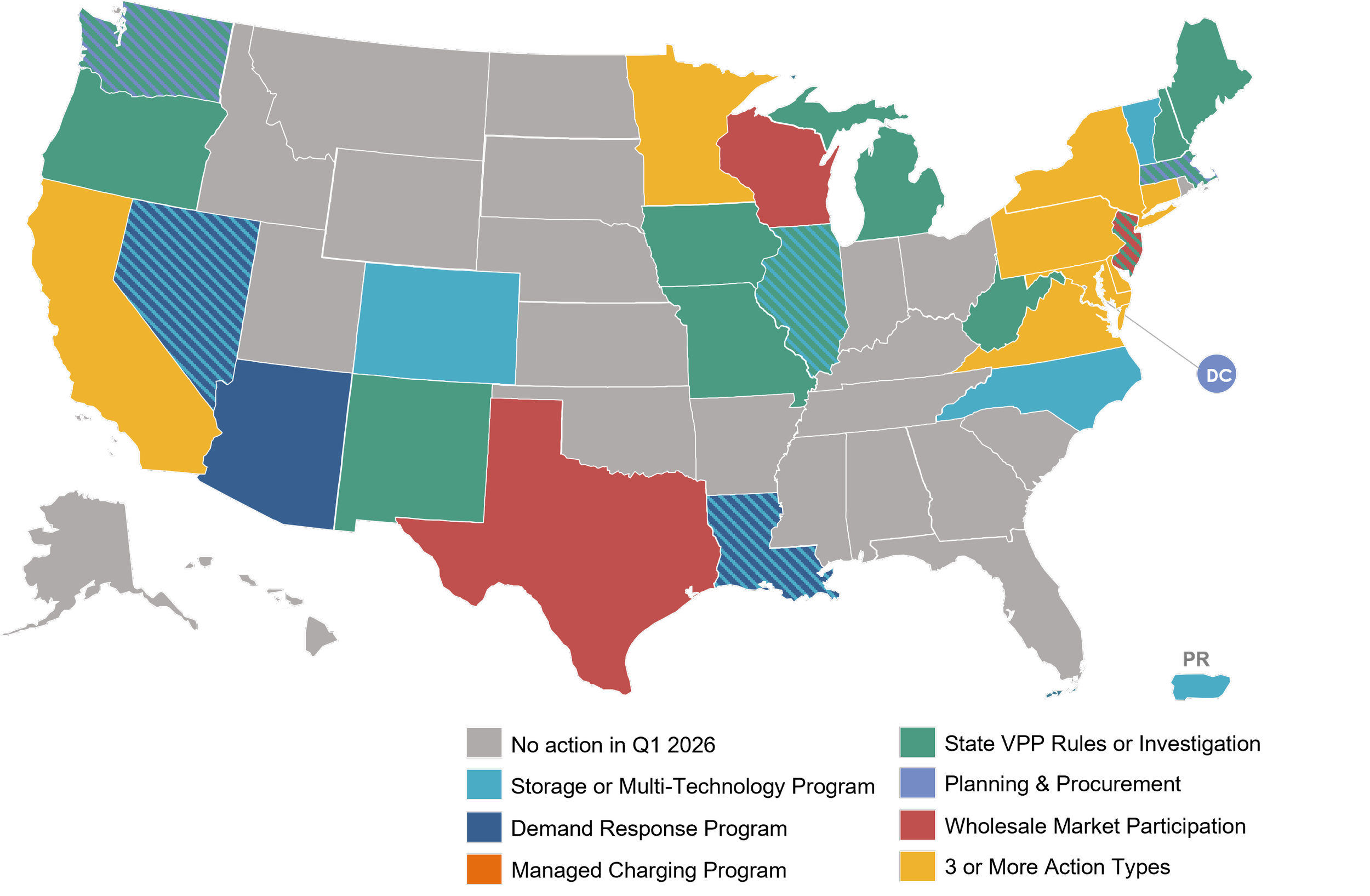
The three U.S. maps below illustrate the breadth, prevalence, and type of VPP and supporting DER developments in Q1 2026. State-by-state summaries of major Q1 2026 developments follow.
Figure 1: State and Utility Actions Addressing VPPs and Supporting DERs, Q1 2026
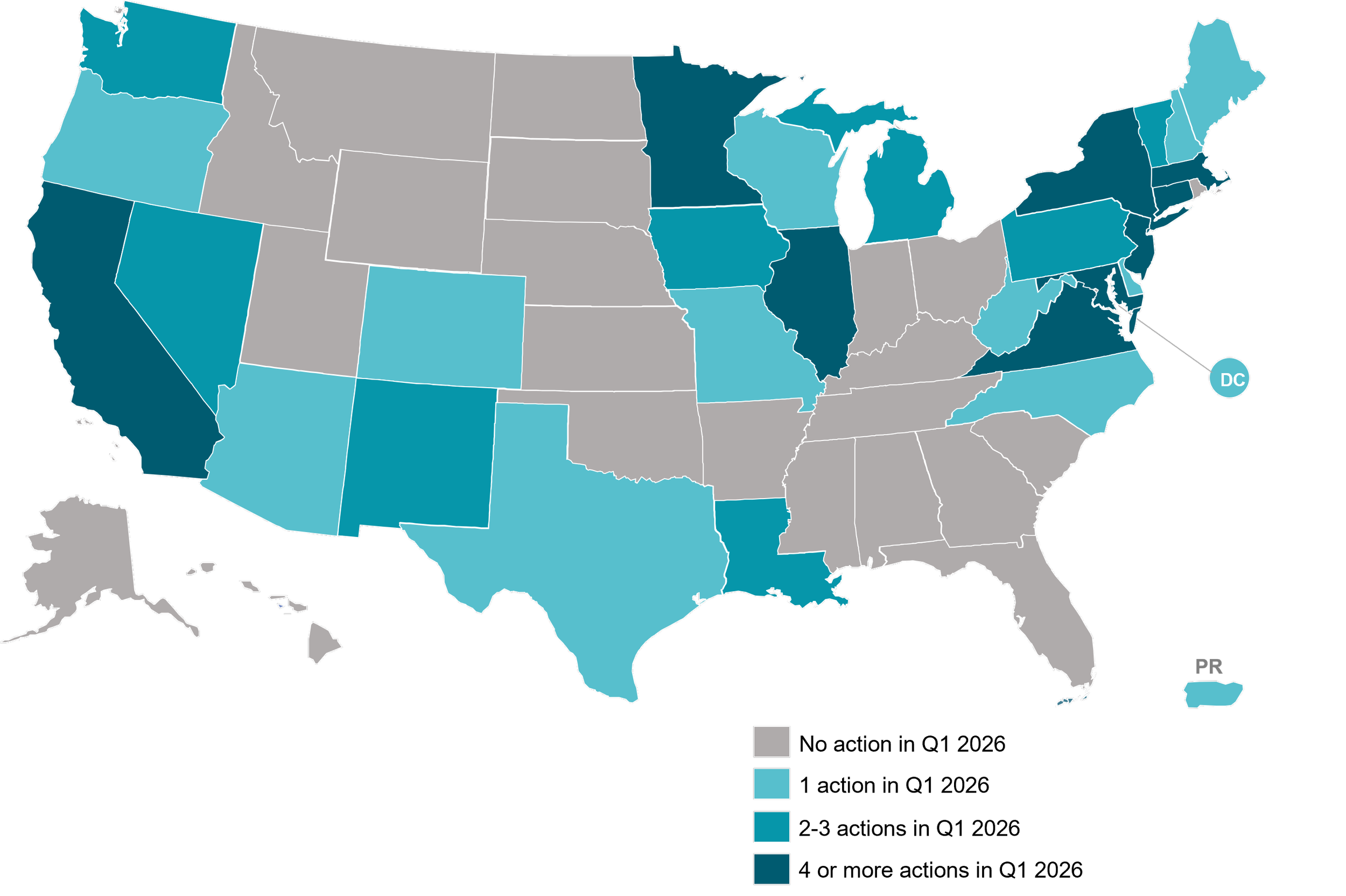
Figure 2: Legislative and Regulatory Actions Addressing VPPs and Supporting DERs, Q1 2026
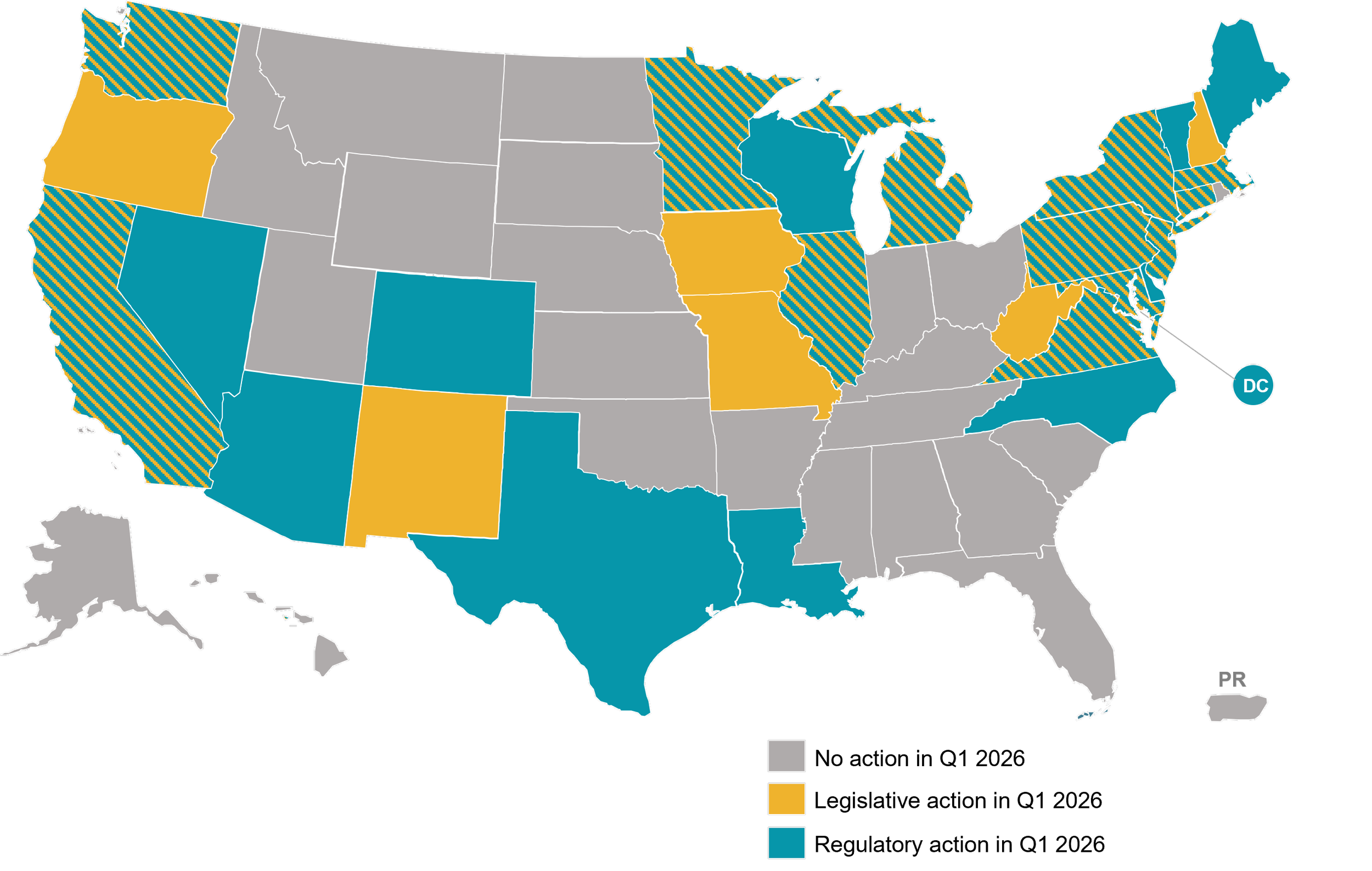
Figure 3: VPP and Supporting DER Actions by Type, Q1 2026
Illinois
S.B. 25 (State Rules) – Enacted
Enacted in January, S.B. 25 directs the Illinois Commerce Commission (ICC) to establish a scheduled dispatch VPP program by June 30. Under the program, storage systems that receive a rebate under another new program established by S.B. 25 (Illinois Storage for All) and community renewable energy generation projects paired with energy storage systems must participate. Participation during called events must be at least $10/kW of average dispatch. Utilities will file an initial scheduled dispatch VPP tariff by June 1, for ICC approval by June 30.
S.B. 25 establishes a timeline for another new VPP program that will allow customers with battery storage, non-battery storage, and EVs to enroll devices in the program via aggregators or directly with a utility. (The VPP program described above applies only to customers eligible for energy storage rebates). Large utilities must propose a VPP tariff by the end of 2027, for ICC approval by the end of 2028.
Illinois
Docket No. 25-0678 (Utility Storage Program) – Pending
In February, Commonwealth Edison (ComEd) proposed a new Bring Your Own Device Load Reduction (BYODLR) Program, having withdrawn a similar previous proposal following the passage of S.B. 25. The newer proposed BYODLR Program – which ComEd plans to eventually incorporate into a VPP program – expands eligibility (and provides incentives) to residential retail customers who enroll in a smart thermostat or thermal storage device.
Maryland
Public Conference No. 77 (Utility Storage Program, DR Program, Managed Charging Program) – Pending
In March, the Maryland Public Service Commission (PSC) launched an initiative focused on demand-side management (DSM) programs, rate design, and DER integration in coordination with the state’s 2024 DRIVE Act. In response, electric utilities have submitted inventories of all existing DSM and rate design measures, their anticipated MW reduction potential, and any impacts on DRIVE Act proposals (filed in Case 9761). The PSC also directed utilities to file, by August, proposals to increase participation in DSM programs and time-based rates.
Massachusetts
Executive Order 654 (State Target) – Signed/Issued
Executive Order 654, issued in March, aims to support energy affordability and independence, strengthen community resilience, and meet growing power needs. It sets capacity targets for 2035, including 5 GW of additional energy storage and 3.5 GW from new load-management strategies (such as VPPs), while taking steps to expedite storage deployment. E.O. 654 also directs the Massachusetts Department of Public Utilities to require electric utilities to fast-track DER and VPP deployment.
Minnesota
Docket No. 25-378 (Planning & Procurement) – Decided
In April, the Minnesota Public Utilities Commission approved Phase 2 of Xcel Energy’s proposed Capacity*Connect program, allowing Xcel to deploy, by the end of 2028, up to 200 MW of utility-owned, utility-operated, front-of-the-meter battery storage systems ranging from 1 MW to 3 MW. Xcel’s stated objective of this program – which embraces the “distributed capacity procurement” model – is to provide capacity and energy benefits to customers without requiring major interconnection, upgrades, and investment in the bulk system. The program budget for the full 200-MW deployment is $430 million through 2028, with costs recovered via Xcel’s Renewable Energy Standard Rider. Xcel also plans a limited deployment of a DER management system (DERMS) to support Capacity*Connect.
New Jersey
Executive Order 2 (State Rules) – Signed/Issued
Executive Order 2, issued in January, directs the New Jersey Board of Public Utilities (BPU) to begin developing, within 180 days, a VPP program designed to reduce peak demand by aggregating behind-the-meter DERs. Utilities and third-party suppliers will administer the program. As part of this effort, the BPU will identify opportunities to facilitate greater competitiveness of DER aggregators in order to generate customer savings, and will develop rules to enable aggregated DERs to participate in the PJM capacity market to the extent possible.
Puerto Rico
Docket No. NEPR-MI-2026-0002 (Utility Storage Program) – Pending
In March, LUMA proposed a new “three-year plan” for energy efficiency and demand response (DR), which actually covers a two-year period (i.e., FY 2027, FY 2028). The proposed plan would maintain the Customer Battery Energy Sharing program, which leverages distributed batteries for energy during grid emergencies, as a full emergency DR program through FY 2028. The program provides an incentive of $1.25/kWh to aggregators, who may establish their own customer-facing incentive structure. LUMA proposed to continue auto-enrolling program participants, who now exceed 80,000. The Puerto Rico Energy Bureau (NEPR) has ordered LUMA to propose performance incentive mechanisms (PIMs) and associated targets for its plan.
Vermont
Docket No. 26A-009 (Utility Storage Program) – Planned
In January, Green Mountain Power (GMP) filed notice of a Resilient Neighborhood 2.0 Innovative Pilot, which builds on GMP’s existing Resilient Neighborhood Innovative Pilot. The first pilot created the state’s first fully electric neighborhood that is resilient to storms and other grid disruptions, while also serving as a grid asset that benefits all GMP customers. The new pilot expands this work in the same neighborhood by extending the pilot to more homes and testing additional grid use cases for the battery fleet. The stated goal of the new pilot is to arrive at a scalable, whole-home resiliency package model that can be deployed with developers and homeowners beyond the pilot neighborhood, while continuing to benefit non-participating customers.
Virginia
H.B. 562 / S.B. 487 (State Rules) – Enacted
S.B. 487, enacted in March, authorizes electric cooperatives to create and implement VPP programs beginning in 2027. A VPP is defined as an aggregation of DERs, enrolled either directly with an electric cooperative or indirectly through an aggregator, that are operated in coordination to provide grid services. Electric cooperatives that develop a VPP may offer incentives for residential battery systems and must evaluate methods to optimize program demand holistically.
Virginia
H.B. 285 / S.B. 223 (Investigation) – Enacted
H.B. 285 and S.B. 223 create a DER Task Force – an advisory commission within the executive branch – that would develop a comprehensive strategy to advance energy affordability and the state’s transition toward integrated DER markets, while supporting compliance with Federal Energy Regulatory Commission (FERC) Order 2222. It would also recommend to the Virginia State Corporation Commission how to improve DER interconnection standards and timelines, as well as policies or actions to advance solar-and-storage microgrids, community resiliency hubs, and VPPs.
Virginia
H.B. 1467 (State Rules) – Enacted
This new law requires Appalachian Power to propose, by July 2027, a pilot program to evaluate methods to optimize demand through various technology applications, including the creation of VPPs. The pilot must consist of DER aggregations totaling up to 150 MW. Appalachian Power could use any existing or proposed distributed energy programs as part of the pilot and to advance VPP deployment.
Looking Ahead
We are expecting one known major regulatory development in Q2 2026. In Illinois, investor-owned utilities must file an initial scheduled dispatch VPP tariff by June 1; the Illinois Commerce Commission will establish the scheduled dispatch VPP program by June 30.
Contacts
SEPA and NCCETC collaborated to develop this summary of state policy developments addressing VPPs and VPP-supporting DERs in Q1 2026. We anticipate publishing additional quarterly updates in 2026.
Autumn Proudlove, NCCETC: afproudl@ncsu.edu
Rusty Haynes, SEPA: rhaynes@sepapower.org
Additional Resources
DSIRE Insight Policy Tracking (Grid modernization tracking includes VPPs)
DSIRE® (Database of State Incentives for Renewables & Efficiency)
SEPA Customer Programs Working Group (virtual monthly meetings)
SEPA Distribution System Working Group (virtual monthly meetings)
RE+ Mid-Atlantic 2026 (Philadelphia, PA; August 12-13, 2026)
RE+ 2026 (Las Vegas, NV; November 16-19, 2026)