
By: Justin Lindemann, Project Manager (NCCETC) and Rusty Haynes, Senior Manager for Research & Industry Strategy (SEPA)
One year ago, we described how the U.S. data center boom was prompting electric utilities, regulators, and policymakers to scramble to accommodate these new large loads that can exceed 1,000 megawatts (MW). This market segment continues to expand and evolve at an astonishing pace. A recent EPRI study found that data centers could consume up to 17% of U.S. electricity generation by 2030 – twice their current level, and 60% higher than 2024 estimates.
Understanding this rapidly evolving challenge, NC Clean Energy Technology Center (NCCETC) and the Smart Electric Power Alliance (SEPA) created the Database of Emerging Large-Load Tariffs (DELTa), a living, public resource designed to help states and utilities plan for load growth, fairly distribute costs and benefits, and support policy objectives.
Q1 2026 Updates
Following a fresh round of updates on March 31, 2026, DELTa now provides summaries and analyses of 77 approved and proposed tariffs and service rules targeting large-load customers of 60 different utilities.
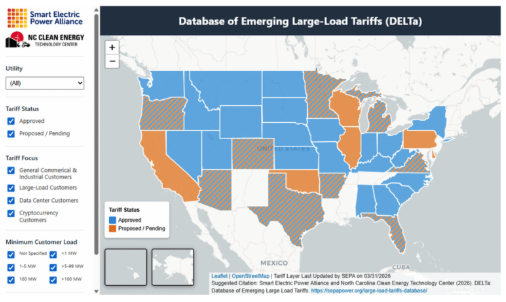
DELTa allows us to understand emerging trends across the sector, including the following key data points:
51: Total number of approved utility tariffs and service rules targeting large-load customers
26: Total number of proposed utility tariffs and service rules targeting large-load customers that are currently awaiting regulatory approval
36: Number of states with one or more utility tariffs or service rules (approved + proposed) targeting large-load customers
56%: Portion of utility tariffs and service rules (approved + proposed) targeting large-load customers that specify a threshold greater than 20 MW
14%: Portion of utility tariffs and service rules (approved + proposed) targeting large-load customers that specify a minimum load of 100 MW
DELTa’s latest update illustrates two clear, specific trends. First, the number of approved and proposed tariffs and service rules continues to grow quickly. In 2025 alone, state regulators approved 29 large-load tariffs. By comparison, DELTa includes only 14 large-load tariffs approved between 2018 and 2024.
Second, there is increased attention to serving only the very largest new customers through large-load tariffs. Of the tracked large-load tariffs approved prior to 2025, nearly all distinguished large loads from other commercial and industrial customers by using thresholds no higher than 25 MW. In contrast, about two-thirds of the large-load tariffs and service rules approved in 2025 distinguish large loads using much higher minimum thresholds, ranging from 50 MW to 150 MW.
States step in, with an eye on affordability
Some states are shifting from relying on utilities to propose their own large-load tariffs toward a more top-down, state-driven approach to developing tariffs and service rules. States are taking these actions against a backdrop of federal efforts on energy affordability, such as the White House’s Ratepayer Protection Pledge, which aims to shield electricity customers from grid costs associated with data centers. Several significant state actions are summarized below.
Pennsylvania
The Pennsylvania Public Utility Commission (PUC) has been developing a model large-load tariff that will serve as a statewide framework to help ensure that large-load customers can connect to the grid quickly and responsibly, while also supporting long-term reliability. The PUC also cited a broad consensus among stakeholders on the fundamental principle of cost causation and the need to protect ratepayers from unreasonable cost shifting.
In November 2025, the PUC proposed a model tariff that includes the following features:
A minimum demand of 50 MW, or 100 MW in aggregate
A minimum contract term of five years, and a three- to five-year load ramp as the default
A minimum billing demand of 80% of contracted demand
Financial security sufficient to cover appropriate network upgrades
A provision to allow customers to reduce load by up to 20%, with adequate notice, after the initial contract term
Lower charges for customers with onsite generation, unused interconnection capacity, or interruptible service
Annual contributions to the host utility’s hardship fund, with the minimum amount to be contributed based on the customer’s peak demand.
New York
In February 2026, the New York Public Service Commission (PSC) launched a new proceeding to execute Governor Kathy Hochul’s Energize NY Development initiative. The initiative will assess and modernize how large loads connect to the state’s transmission and distribution grids, while ensuring that projects that drive significant system demand pay their fair share of the associated costs.
The new proceeding will explore potential revisions to the planning and interconnection processes, cost-allocation mechanisms, and tariff structures relating to the integration of large loads within New York’s transmission and distribution systems. The PSC has invited stakeholders to respond by May 13 to questions that address, among other things, the structure and mechanics of large-load grid services, transparency, ratepayer protection, grid reliability, and meeting the state’s climate goals.
North Carolina
In August 2025, North Carolina Governor Josh Stein issued an executive order establishing the North Carolina Energy Policy Task Force. The Task Force’s February 2026 interim report includes nine preliminary recommendations on policies and actions to manage increasing electricity demand, while maintaining affordability, reliability, and emissions reductions.
Notable recommendations call for developing options for large-load tariffs, “Bring Your Own Capacity,” and alternative capacity procurement methods; for demand-side management tools (e.g., load flexibility); and for considering large-load and generation interconnection processes and advanced transmission and grid-enhancing technologies. The Task Force plans to expand its work on affordability and ratepayer protections this year.
But wait! That’s not all …
Several other states are pivoting to or exploring a statewide approach to governing large-load customers from an energy and ratepayer-cost perspective. Examples include:
Utah: Legislation (S.B. 132) enacted in March 2025 established new requirements and options for large-load facilities expected to reach at least 100 MW within five years. For such planned facilities, if Rocky Mountain Power (RMP) determines it cannot serve the facility without major system upgrades and costs, the facility may seek its own energy supply. (The new law also required the Utah Public Service Commission to investigate a flexible tariff for large loads in RMP’s service territory; this investigation is currently in progress.)
Texas: Legislation (S.B. 6) enacted in June 2025 has four primary objectives related to large-load growth: (1) ensuring transmission costs are properly allocated, (2) establishing grid reliability protection measures, (3) bringing transparency and credibility to load forecasting, and (4) protecting residential customers from outages by requiring large loads to share the load-shed obligation during times of shortage.
California: Legislation (S.B. 57), enacted in October 2025, directs the California Public Utilities Commission to investigate whether utility costs associated with new loads from data centers result in cost shifts to other customers, and to publish its findings by January 1, 2027.
Missouri: In January 2026, Governor Mike Kehoe issued an executive order directing state agencies, including the Missouri Public Service Commission, to investigate regulations and infrastructure planning in light of growing energy demand from data centers supporting AI, with a focus on ratepayer protection and addressing energy needs.
Looking ahead
Considering the critical importance and intersection of the two massive policy and economic forces currently at stake – the race for AI dominance and ensuing data center gold rush, and energy affordability – we expect to see more impactful developments over the next few months. In particular, the Federal Energy Regulatory Commission is expected to take action by June 2026 on its Advance Notice of Proposed Rulemaking (ANOPR) to propose reforms on how large loads interconnect to the transmission system. Brace yourself for more large-load tariff action at the national, state, and utility levels.
Contact Information
NCCETC and SEPA developed and maintain the Database of Emerging Large-Load Tariffs (DELTa). Going forward, DELTa updates will be implemented and announced quarterly. To receive notifications of new developments, please submit the form on DELTa’s home page.
Authors:
Justin Lindemann, NC Clean Energy Technology Center, jplindem@ncsu.edu
Rusty Haynes, Smart Electric Power Alliance, rhaynes@sepapower.org