
By: Nick Montoni, Sr. Program Director; Rebekah de la Mora, Sr. Policy Analyst; and Justin Lindemann, Sr. Policy Analyst
Recent conversations about energy affordability and reliability have focused on load growth: due to factors like economic development spurring the need for new manufacturing and data centers, population growth, and a general trend towards electrification of homes, businesses, and transportation, the demand for electricity is expected to rise sharply across the country over the next decades. While discussing how to respond to these drivers of load growth, some thought leaders, academics, and others have pointed to policy levers that regulate large loads, in particular utility tariffs that apply to large loads. It’s easy to conflate these large load tariffs, which apply broadly to any customer with high electricity demand, with a policy lever meant to target data centers specifically. However, it’s important to draw a distinction between large load tariffs and data center-specific tariffs, and clarify when tariffs are and are not “aimed at” data centers.
Large Load Tariffs and Data Center Tariffs
A tariff in this context is a utility document or contract that lays out terms and conditions for consumers of electricity (not to be confused with the other kind of tariff, which is a tax on imported or exported goods). A large-load tariff (LLT) is a tariff that applies specifically to electricity consumers of a particular size; the size and characteristics of the load are specific to each LLT, so a “large-load” may be of a different size in each jurisdiction. A data center tariff (DCT) is a more specific large-load tariff that applies uniquely to the customer class of data centers.
Proposed and Approved LLTs and DCTs (March 2026)
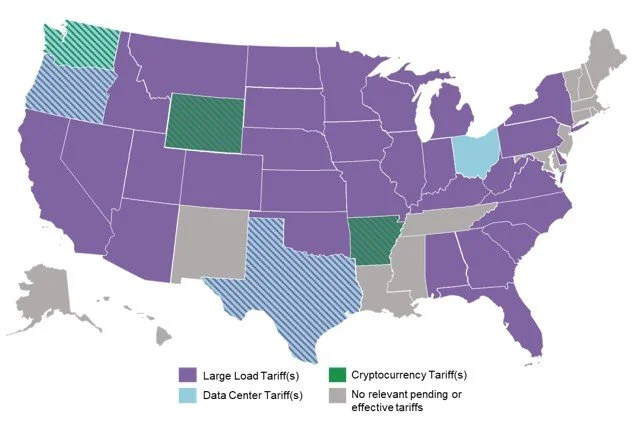
Currently, according to the Database of Emerging Large Load Tariffs (DELTa, maintained by the North Carolina Clean Energy Technology Center and the Smart Electric Power Alliance), there are 77 approved or pending LLTs (or associated services rules) across the country. Of those, five are DCTs:
Chelan County Public Utility District Rate Schedule 36 in Washington
Pacific Power Schedule 401 in Oregon [proposed]
AEP Ohio Schedule DCT (which is being litigated for alleged discrimination against data center customers)
El Paso Electric Riders T-33A and T-33B in Texas
These LLTs also include three that are specific to cryptocurrency customers:
Entergy Arkansas Rate Schedule 69 [proposed]
Grant County Public Utility District Rate Schedule No. 17 in Washington
Cheyenne Light, Fuel and Power Company Schedule BCIS in Wyoming
The table below looks at LLTs in select states and differentiates them by customer class.
Examples of Proposed and Approved LLTs and DCTs
Conclusion
Large-load tariffs and data center tariffs are different legal documents: large-load tariffs apply broadly to all electric loads of a specific size, with that size being determined by the terms of the tariff. Data center tariffs are a specific kind of large-load tariff that applies uniquely to data center customers and are in a class with other industry-specific tariffs. Notably, there are very few data center-specific tariffs across the country, and one of those is currently the subject of ongoing litigation for allegedly discriminating against an entire customer class. It is important that analysts and thought leaders in energy policy speak about these documents accurately and with precision to avoid confusion about the role and impact of utility legal documents.
For more information on all of the LLTs across the country, including those that are DCTs or apply to other specific industries, see the Database of Emerging Large-Load Tariffs (DELTa). For additional information on large load customer treatment in addition to utility tariffs, see the 50 States of Power Decarbonization report series.