By: Hannah Budds, Project Manager
Over the past couple years, a trend in the realm of energy policy has quietly emerged across several states; governors establishing new energy task forces through executive orders. This pattern is bipartisan, as both Democratic and Republican governors have taken steps to create novel entities dedicated to tackling today’s pressing energy challenges. Some state legislatures have also taken the initiative to establish task forces focused on energy issues, such as Maine’s Electric Ratepayer Advisory Council and South Carolina’s Nuclear Advisory Council. However, this discussion focuses on gubernatorial action given that it has been a unique pattern over the last couple years. Coinciding with dominant discourse on load growth, governors are primarily justifying these actions through concerns about affordability, reliability, and electricity demand growth due to data centers, population increases, reshoring of manufacturing, and consumer electrification.
These task forces often address a wide range of topics, but some of the most common issues are affordability, Bring Your Own Capacity (BYOC) programs, distributed resource aggregation, interconnection and permitting reform, large load cost allocation and flexibility, small modular reactor development, and much more. Of note, there are three primary categories that these task forces fit into: (1) all-encompassing energy task forces, (2) nuclear-specific task forces, and (3) data center-focused task forces. The first category includes task forces with a gubernatorial directive that span a wide range of energy topics, rather than a single focus area. Alternatively, nuclear and data center task forces have more targeted purposes. While nuclear task forces are actively examining issues like evaluating opportunities for small modular reactor deployment and identifying nuclear training and workforce needs, data center-focused task forces are looking into issues like balancing the benefits and risks associated with data centers and fairly assigning data center development costs to companies that trigger them. There are often areas of overlap between them, but these designations are helpful in discerning the main impetus behind each task force.
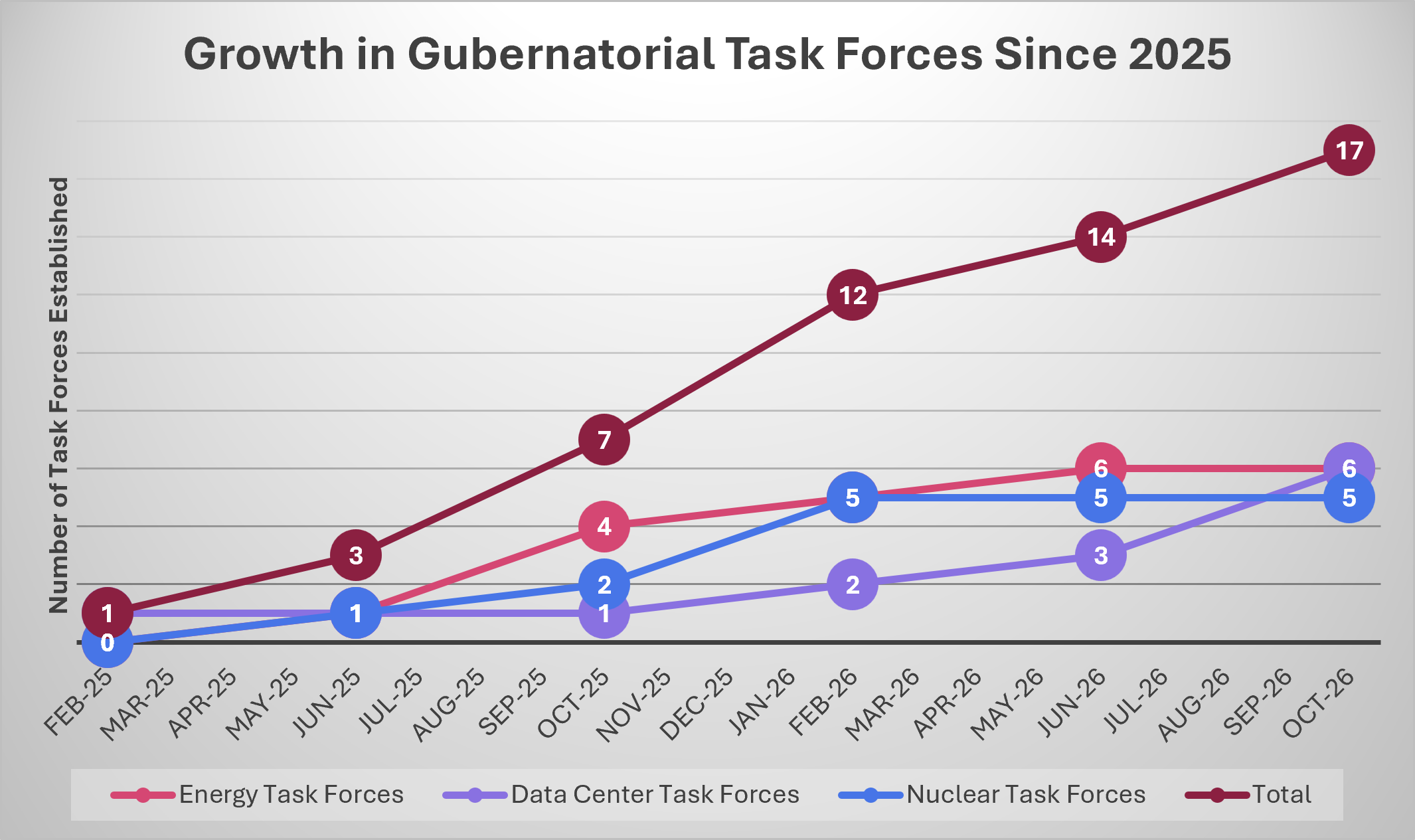
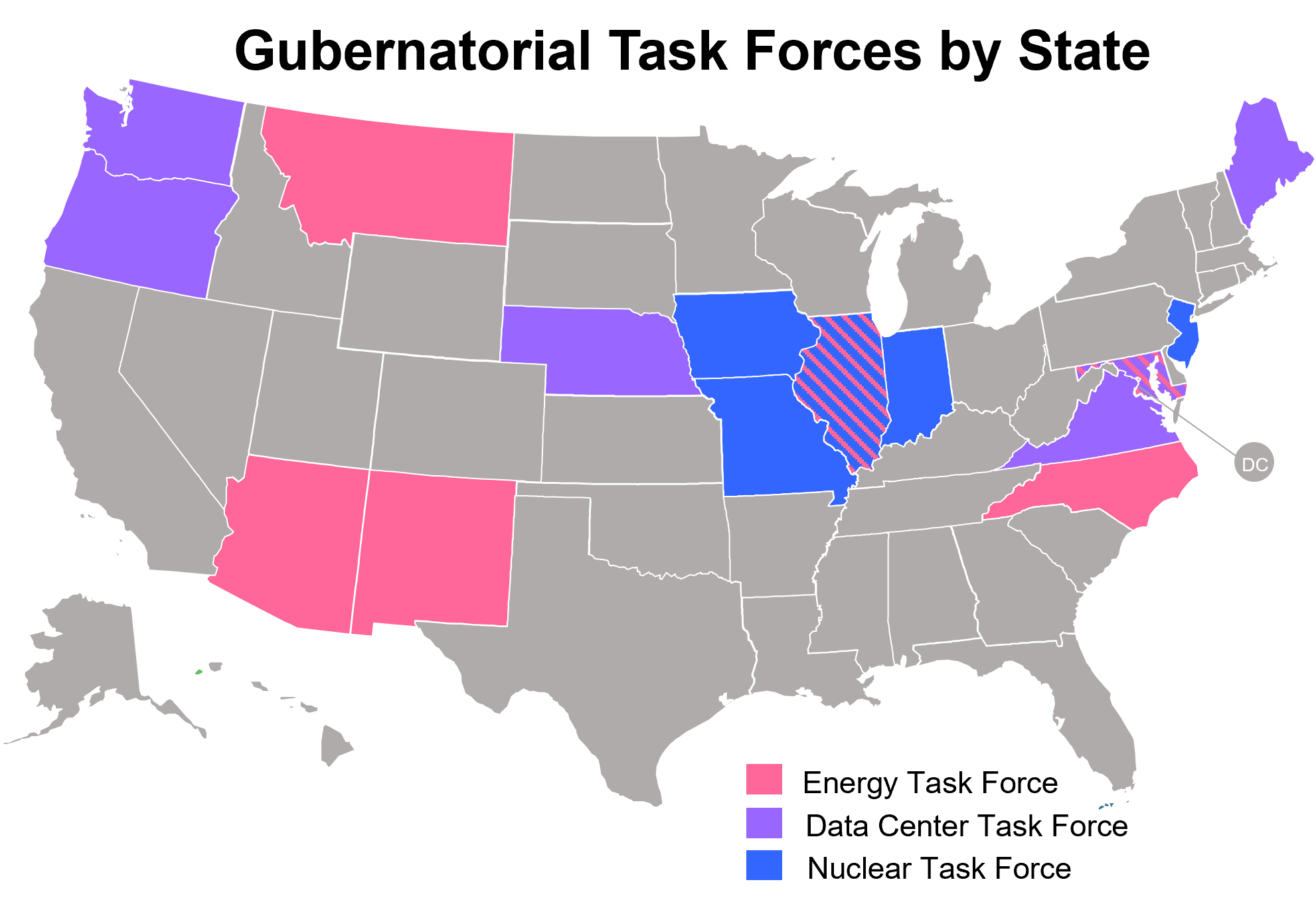
Zooming in, governors have created at least 17 new task forces focused on energy issues since February 2025.
Indiana Strategic Energy Growth Task Force
Established by Governor Mike Braun in June 2025 through Executive Order 25-66, the Strategic Energy Growth Task Force was formed to develop a plan for the state to meet its growing energy needs with reliable, affordable energy. E.O. 25-66 laid out specific deliverables for the Task Force, including a State Energy Growth Plan with short- and long-term planning milestones and an analysis of key drivers of electricity prices over the past 20 years with associated recommendations. Additionally, this directive called on the Task Force to partner with various entities to support streamlining permitting, identifying new large industrial developer and clean energy industrial hubs, and prioritizing dispatchable energy resources.
The Task Force’s major deliverable is the Strategic Energy Growth Plan, which it released in July 2026. Elevating 10 different recommendations, this plan ties each recommendation to five-year actions (which are primarily legislative calls-to-action) and 20-year outlooks (which are long-term goals reflecting the ideal outcomes from taking near-term actions). In terms of protecting Indiana’s ratepayers from costs associated with power generation built to serve large loads, the Task Force advocates for legislative additions that would create an expedited regulatory approval pathway for large load customers that commit to paying 100% of project costs. To address local government barriers related to siting renewable energy projects, the Task Force suggests legislation that would compensate counties that host solar and wind facilities through a per-MW payment structure for the life of the facility. Among other regulatory recommendations, the Task Force also endorses legislation directing the Indiana Utility Regulatory Commission to open a docket dedicated to investigating performance-based ratemaking (PBR) mechanisms, ultimately deciding whether to pilot PBR within three years.
North Carolina’s Energy Policy Task Force
Established by Governor Josh Stein in August 2025 through Executive Order No. 23, the Energy Policy Task Force is entrusted with guiding state policymakers on how to manage increasing electricity demand while maintaining adequate, reliable, affordable, and clean electricity for North Carolina. The Task Force was also directed to create a Load Growth Subcommittee to focus on large load customer treatment, load forecasting, large load-specific policy solutions, and minimizing rate increases associated with new large loads. Additionally, the Task Force had to form a Technical Advisory Subcommittee charged with electricity system modeling, strengthening public understanding of energy policy, and producing any quantitative and qualitative assessments resulting from formulated research questions.
Earlier this year, the Energy Policy Task Force circulated its interim report in February. Given that this is an interim report, the focus is on broadly defining the sphere of action for the Task Force. Targeting nine different topic areas, the Task Force put forward policy-specific recommendations along with details regarding the relevant entity to act, the timeline, and any additional considerations in terms of pros and cons, barriers to implementation related to existing state policy, and examples from other states. Notably, the report continued to consider options for large load tariffs and potential parameters to be included, such as eligibility based on load size, avoiding cross-subsidization, and load flexibility. On potential BYOC frameworks, the report refers to examples such as NV Energy’s Clean Transition Tariff, Dominion Energy’s Carbon-Free or Renewable Generation Supply Service tariff, and Georgia Power’s Bring Your Own New Clean Energy program. In terms of next steps, the Task Force is continuing to consider options for enabling legislation that opens procurement pathways for large loads, a clean transition tariff, a BYOC provision within a large load tariff, or sleeved power purchase agreements. Additional recommendations address load flexibility options, interconnection reform, existing sales and use tax exemptions, advanced transmission technologies (ATTs), energy efficiency incentives, load forecasting, and data center energy and water usage. The upcoming final report that is due February 15th, 2027, will deliver more in-depth proposed actions for relevant state policymakers and regulators.
Montana Governor’s Energy Task Force
Established by Governor Greg Gianforte in September 2025 through Executive Order No. 6-2025, the Energy Task Force is charged with developing both short- and long-term strategies to increase Montana’s affordable and reliable energy options. Specifically, the Task Force must focus on recommending measures that the governor and the legislature can implement.
In the Task Force’s final report published in August 2026, there are 20 recommendations directed toward key action areas: reforming utility regulation, evaluating the need for an executive branch-led energy coordinating entity, advancing regional markets and transmission development, driving economic development, right sizing the state’s energy tax framework, building an innovative, reliable power supply, and optimizing grid utilization and controlling consumer energy costs.
At the top of the list, the Task Force proposes legislative changes to transition the Montana Public Service Commission from an elected body to an appointed body. Additionally, the Task Force suggests more coordinated state involvement in the regional power system and subsequent public education efforts regarding electricity markets, strengthened executive branch involvement in areas like interstate transmission development and long-term demand for and supply of power generation, legislative direction on creating a more efficiency regulatory process to serve new loads larger than 5 MW, and encouragement of demand flexibility and expedited interconnection. A few other notable recommendations include the development of a technology-neutral property tax abatement structure, state policy frameworks on geothermal and nuclear energy, and a study on the potential for virtual power plants (VPPs) to reduce peak demand and improve grid utilization. Unless it is extended, the Energy Task Force will terminate after September 30, 2027.
Arizona Energy Promise Taskforce
Established by Governor Katie Hobbs in September 2025 through Executive Order 2025-13, the Arizona Energy Promise Taskforce’s mission is to increase access to affordable and secure energy for all Arizonans and reduce barriers to the state’s energy and economic future. In addition to establishing the Taskforce, E.O. 2025-13 directed all executive agencies to develop a plan to reduce energy consumption by 5% by June 30th, 2027, and to report annually to the Office of Administration regarding any energy reduction and utility bill cost saving projects.
The Taskforce published its first report to the governor in March 2026, including a large loads policy framework, an energy strategy plan that analyzes different power generation technologies, and a generation and transmission corridor strategic plan aimed at streamlining energy infrastructure deployment. In total, the Taskforce produced 31 recommendations about large loads, strategic energy planning, geothermal, nuclear, and generation and transmission. Some of the large load recommendations urge study of BYOC proposals from other states and collaboration between utilities and large load customers on load flexibility pilots. Additional recommendation topics include identifying funding to expand VPP programs, streamlining state permitting of ATTs, creating a geothermal playbook to help guide project development, and exploring public and private financing sources to reduce upfront investments for nuclear energy development.
Maryland Energy Advisory Council
Established by Governor Wes Moore in December 2025 through Executive Order 01.01.2025.27, the Energy Advisory Council is directed to seek out input on energy affordability and reliability challenges. The Energy Advisory Council will provide stakeholder input to the Energy Subcabinet within the Governor’s Office, which was established within the same executive order. In addition to launching new energy-focused work groups, Gov. Moore also outlined action items related to mitigating rate impacts through state energy planning and legislative coordination, reviewing utility budget billing programs, adopting interconnection speed, customer affordability, non-wires alternatives (NWAs), and other performance incentive mechanisms, requiring utility evaluation of ATTs, and more.
Most recently, the Energy Advisory Council sent a memorandum to the Governor’s Energy Subcabinet in June 2026, which provided a summary of existing energy affordability and reliability challenges and described a potential path forward. Among the barriers listed, the Advisory Council cites sharply increasing capacity costs within regional transmission organization PJM, load growth due to large loads, and speed to power as some of the top issues. Moving over to solutions, the Advisory Council suggests a more comprehensive approach to incorporating confirmed large load interconnection requests in planning, scaling demand response and VPP integration, increased scrutiny of utility capital investment plans and alternatives to traditional infrastructure (like NWAs and ATTs), aligning rates with cost causation, developing statewide affordability definitions and metrics, and advocating for reforms to PJM’s capacity market design. Unless it is extended, the Maryland Energy Advisory Councill will terminate after December 31, 2027.
New Mexico Energy Affordability and Grid Reliability Council
Established by Governor Michelle Grisham in April 2026 through Executive Order 2026-023, the Energy Affordability and Grid Reliability Council strives to balance alleviating rising electricity costs with building out the grid to meet growing demand. Additionally, Gov. Grisham emphasized that the Council will take steps to promote clean energy development in service of the state’s net-zero emissions by 2050 goal. While the Council must produce a final report with recommendations to the governor and the legislature by November 1, 2026, it has not yet been released. However, the governor outlined four areas of focus for the report: (1) protecting ratepayers from costs associated with new large loads; (2) devising a modern, reliable grid that prioritizes affordable expansion; (3) advancing the state’s net-zero goals through procurement of clean generation and storage; and (4) establishing more efficient local and state permitting process to accelerate the clean energy transition. In the executive order, there is also an emphasis on recommending strategies that eliminate any disproportionate cost burdens on residential, rural, tribal, and small business customers.
Data Center Task Forces:
· Washington Data Center Workgroup – Established February 2025
· Oregon Data Center Advisory Committee – Established January 2026
· Maine Data Center Advisory Council – Established April 2026
· Nebraska Data Center Task Force – Established July 2026
· Virginia AI Task Force – Established September 2026
· Maryland Data Center Accountability Task Force – Established September 2026
Nuclear Task Forces:
· Nuclear Indiana Coalition – Established April 2025
· Idaho Advanced Nuclear Task Force – Established September 2025
· Iowa Nuclear Energy Task Force – Established January 2026
· New Jersey Nuclear Task Force – Established January 2026
· Missouri Advanced Nuclear Energy Task Force – Established January 2026